The AI Visibility Playbook: ChatGPT Ads Are Live - Here's How to Prepare Your Brand
On this page
On February 9th, 2026, OpenAI began testing advertising inside ChatGPT.
Sponsored placements are now rolling out to a subset of US users on the free and Go tiers. They show up at the bottom of responses when there's a relevant match to the conversation. Plus, Pro, Business, Enterprise, and Education plans remain ad-free.
It's important to understand what this is right now: a limited test. OpenAI has been explicit about that. There is no public self-serve ad platform. The initial beta requires a reported $200,000 minimum spend commitment, effectively limiting participation to enterprise brands and major agency groups. OpenAI says they're "starting with a test to learn, listen, and make sure we get the experience right" before expanding. (OpenAI blog, Feb 9, 2026)
But even in test mode, this is a turning point. Not because of the ads themselves, but because of what they signal: ChatGPT is already a brand discovery channel, and the paid layer is about to make that impossible to ignore.
This playbook breaks down what's happening, why it matters, and exactly what to do about it right now.
Part 1: The Numbers Behind the Shift#
ChatGPT isn't a novelty anymore. Here's the scale we're dealing with, all sourced:
- 800M+ weekly active users on ChatGPT, confirmed by Sam Altman at OpenAI DevDay in October 2025. (TechCrunch)
- 2.5 billion prompts per day, up from 1 billion just eight months earlier. OpenAI shared this figure with Axios in July 2025. (TechCrunch)
- 527% growth in AI-referred web traffic between January and May 2025, across a Previsible study of 19 GA4 properties. One SaaS site tracked went from 600 ChatGPT visits per month to over 22,000 in that span. (Search Engine Land)
- AI search visitors convert at 4.4x the rate of traditional organic search visitors, based on a Semrush study of 500+ digital marketing topics (June 2025). Separately, Ahrefs found AI visitors to their own platform converted at 23x the rate of organic, though they represented only 0.5% of total traffic.
- AI-referred traffic to retail sites jumped 12x between July 2024 and February 2025. By December 2024, AI visits had reached parity with traditional visits in revenue per visit. (Adobe)
- 36% of generative AI users now say they've replaced traditional search engines with AI assistants entirely. (Adobe, February 2025)
People are using ChatGPT to research, compare, and make buying decisions at a massive and accelerating scale. This isn't a future trend. It's current behavior.
Part 2: What ChatGPT Ads Look Like (and What They Don't)#
OpenAI is being deliberate about this rollout. Here's what we know from their official announcements and industry reporting, and what's important to understand about the current state.
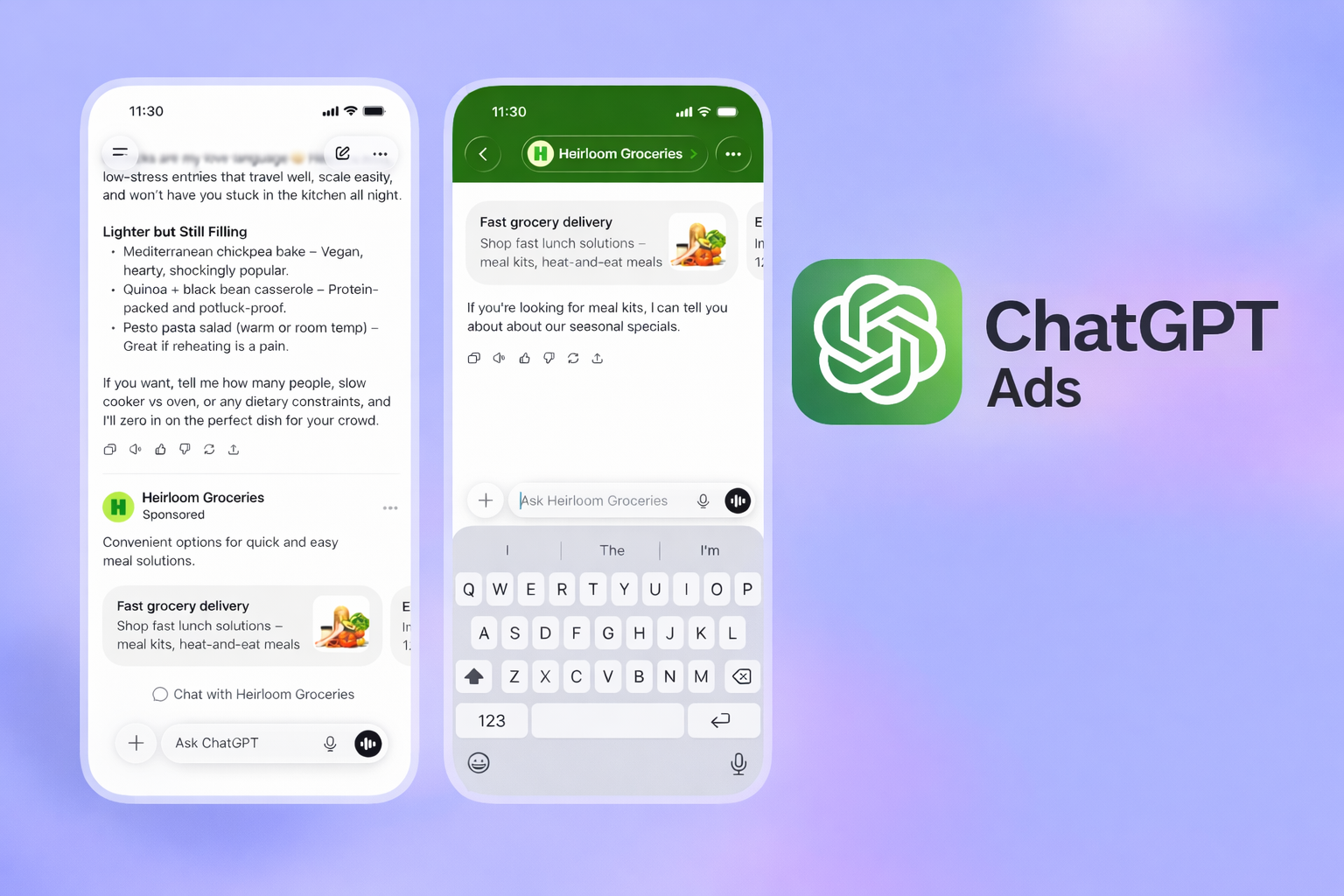
What's live right now#
- Placement: Ads appear at the bottom of ChatGPT responses, clearly labeled as sponsored and visually separated from the organic answer. (OpenAI blog)
- Targeting: Matched to the current conversation topic. With personalization enabled, OpenAI also uses past chat history and ad interaction data. (OpenAI Help Center)
- Pricing: Cost-per-view (impressions-based), not clicks. Reports suggest CPMs around $60, roughly 3-4x Meta's average. (AdExchanger, The Information)
- Audience: A subset of Free and Go ($8/mo) tier users in the US. Not all free users are seeing ads yet. (OpenAI blog)
- Restrictions: No ads for users under 18. No ads near sensitive topics (health, mental health, politics). No ads in temporary chats, after image generation, or in ChatGPT's Atlas browser. Advertisers in dating, health services, financial products, and politics are excluded. (OpenAI Help Center)
What's NOT available yet#
- There is no public self-serve ad platform. You cannot go buy ChatGPT ads today the way you buy Google or Meta ads.
- The private beta requires a reported $200,000 minimum spend commitment, confirmed by ADWEEK. Access is limited to enterprise brands and major agency groups (Omnicom has confirmed 30+ participating clients). (ADWEEK, Campaign US, Storyboard18)
- OpenAI has not published a timeline for general availability. They've said they will "expand gradually" and "evolve our advertising program to support additional formats, objectives, and buying models" over time. (OpenAI blog)
- Revenue ambition: Leaked internal OpenAI documents project $1B in "free user monetization" in 2026, scaling to $25B by 2029. (The Information, Digiday)
What this means for you#
If you're not a brand with a $200K+ test budget, you're not running ChatGPT ads anytime soon. And that's actually fine, because the much bigger opportunity right now is on the organic side. The brands that will be best positioned when the ad platform does open up broadly are the ones who understand their organic AI visibility today.
For context, the day before OpenAI launched ads, Anthropic ran Super Bowl ads poking fun at the concept of advertising inside AI chatbots. (TechCrunch) The industry is clearly split on the approach, but the financial pressure on OpenAI is real.
Part 3: Why Organic AI Visibility Is Your New SEO#
Here's the mistake I see marketing teams making right now: the conversation has immediately jumped to "how do I buy ChatGPT ads?"
The smarter question is: "How does my brand show up in ChatGPT today, before any ads are involved?"
Think about the Google playbook. The brands that won at Google Ads weren't the ones who threw the most money at keywords. They were the ones who understood SEO first, knew where they ranked organically, and used paid to fill specific gaps. The organic intelligence informed the paid strategy.
The same dynamic is about to play out in AI:
- ChatGPT is already recommending brands, comparing products, and shaping purchase decisions in its organic responses.
- Your Google Analytics can't track when ChatGPT recommends your competitor instead of you.
- Emerging research suggests that traditional SEO signals like domain authority don't directly translate to AI visibility. The factors that drive AI citations appear to be different from the factors that drive Google rankings.
- Brand search volume and brand mentions across the web are emerging as stronger predictors of whether AI models cite your brand.
If you don't know how you show up organically in AI, you can't make smart decisions about paid. Full stop.
This is where Generative Engine Optimization (GEO) comes in. GEO is the practice of optimizing your brand's presence so that AI models like ChatGPT, Perplexity, Google Gemini, and Claude can discover, understand, and cite your content. Think of it as SEO for the AI answer layer.
Part 4: The GEO Playbook - How to Improve Your Organic AI Visibility#
This is the tactical section. These aren't theoretical ideas. They're based on emerging research (including studies from Princeton and Georgia Tech showing properly optimized content can boost AI citation rates by up to 40%), confirmed industry practices, and what's actually working right now.
Step 1: Audit Your Current AI Visibility#
Before you optimize anything, you need to know where you stand.
Manual audit (do this today):
- Open ChatGPT (and Perplexity, and Google Gemini).
- Ask 15-20 prompts your customers would realistically ask. Focus on product comparisons, "best of" queries, and problem-solving prompts in your category.
- Document: Does your brand appear? In what position? With what sentiment? Does it link to your site? Who are the competitors that show up instead?
- Repeat weekly. AI responses are not static. They shift as models update and new content enters the training pipeline.
What to track:
- Brand mention rate (what % of relevant prompts mention your brand)
- Position in response (first mention vs. buried at the bottom)
- Sentiment (recommended positively, mentioned neutrally, or flagged negatively)
- Competitor share of voice (who else appears and how often)
- Citation links (does the model link to your site or a third party writing about you)
This is the baseline you'll measure everything else against.
Step 2: Make Your Content Extractable for AI#
LLMs don't consume content the way humans do. They tokenize your HTML, build vector embeddings, and retrieve specific passages to assemble into answers. If your content isn't structured for extraction, it gets skipped.
Content structure principles:
- Lead with the answer. Put your core claim or answer in the first 1-2 sentences of any section. AI models often pull the opening of a passage for citations.
- Use clear semantic headings. H2s and H3s should be descriptive, not clever. "How to Choose a CRM for Mid-Market B2B" is better than "Finding Your Perfect Match."
- Write self-contained paragraphs. Each paragraph should make sense if pulled out of context. AI models extract passages, not full articles.
- Include comparison content. "X vs Y" pages, product comparisons, and "best of" roundups are among the most commonly cited content types in AI responses.
- Add FAQ sections. Include 6-10 natural-language questions with concise, factual answers at the end of key pages. Mirror the prompts your customers actually type into ChatGPT.
- Use tables and structured lists for specs and features. AI models extract tabular data more reliably than dense paragraphs.
- Include statistics with sources. Content that cites credible sources gets cited more frequently by AI. This is backed by research from Princeton and Georgia Tech showing that content with citations, quotations, and statistics saw meaningfully higher visibility in AI responses.
Step 3: Implement Schema Markup (Structured Data)#
Schema markup is how you make your content machine-readable. It tells AI models exactly what each piece of information represents, reducing the need for inference.
In March 2025, Microsoft's Fabrice Canel (Principal Product Manager at Bing) confirmed at SMX Munich that schema markup helps Microsoft's LLMs understand web content. Data from SE Ranking shows that approximately 65% of pages cited by Google's AI Mode and 71% of pages cited by ChatGPT include structured data.
Schema doesn't guarantee AI citations. But it makes your content significantly easier for AI systems to parse, verify, and cite with confidence.
Priority schema types for AI visibility (implement in JSON-LD format):
Organization schema (homepage - do this first): This anchors your brand identity. Include your name, logo, URL, social profiles, founding date, and contact information. This helps AI models consistently recognize and reference your brand.
{
  "@context": "https://schema.org",
  "@type": "Organization",
  "name": "Your Brand Name",
  "url": "https://yourbrand.com",
  "logo": "https://yourbrand.com/logo.png",
  "sameAs": [
    "https://linkedin.com/company/yourbrand",
    "https://twitter.com/yourbrand"
  ],
  "contactPoint": {
    "@type": "ContactPoint",
    "telephone": "+1-800-555-0100",
    "contactType": "customer service"
  }
}
FAQPage schema (FAQ and product pages): Maps questions directly to answers, which is exactly the format AI models use when answering user prompts.
{
  "@context": "https://schema.org",
  "@type": "FAQPage",
  "mainEntity": [
    {
      "@type": "Question",
      "name": "What is [your product category]?",
      "acceptedAnswer": {
        "@type": "Answer",
        "text": "A concise, factual answer here."
      }
    }
  ]
}
Article schema (blog posts and content pages): Include author attribution with Person schema, publication dates, and modification dates. E-E-A-T signals (Experience, Expertise, Authoritativeness, Trustworthiness) matter for AI citations. Content with transparent author bios and reputable citations outperforms anonymous content.
{
  "@context": "https://schema.org",
  "@type": "Article",
  "headline": "Your Article Title",
  "author": {
    "@type": "Person",
    "name": "Author Name",
    "jobTitle": "Their Role",
    "url": "https://yourbrand.com/team/author"
  },
  "datePublished": "2026-02-12",
  "dateModified": "2026-02-12",
  "publisher": {
    "@type": "Organization",
    "name": "Your Brand Name"
  }
}
Product schema (product pages): Include pricing, availability, features, and review data. This helps AI provide accurate product information when users ask for recommendations.
HowTo schema (tutorials and guides): Breaks step-by-step content into a format AI can parse and reference when users ask "how do I..." questions.
Implementation tips:
- Use JSON-LD format (placed in the page
<head>). Google explicitly recommends JSON-LD over Microdata or RDFa. - Target 1-2 schema types per page. Don't overload.
- Make sure the visible on-page content matches what's in your schema. AI models cross-reference.
- Validate with Google's Rich Results Test and Schema Markup Validator before publishing.
- If you're on WordPress, Rank Math or Yoast can handle most of this. Webflow supports JSON-LD blocks natively.
Step 4: Build Your Citation Network#
AI models don't just look at your website. They synthesize information from across the entire web. The more places your brand is mentioned in credible, relevant contexts, the stronger your signal.
Third-party mentions and reviews:
- Customer reviews on platforms like G2, Capterra, Trustpilot, and industry-specific review sites create independent signals that AI models weigh when making recommendations.
- Data from Semrush and others shows that Reddit, LinkedIn, and YouTube were among the top cited sources by major LLMs in late 2025. Create substantive, helpful content on these platforms that addresses real problems in your industry.
PR and earned media:
- Industry press coverage, news mentions, and expert commentary in publications create the kind of third-party validation that AI models use as authority signals.
- Focus on being quoted as an expert source, not just getting a backlink. AI models care about entity recognition (are you consistently mentioned as an authority in your space?), not just link profiles.
Community presence:
- Genuine, helpful participation in Reddit communities, Quora, and industry forums creates earned mentions that AI models surface.
- This isn't about dropping links. It's about being the brand that consistently provides useful answers in the places where your customers already ask questions.
Content partnerships and guest contributions:
- Publish original research, data, and expert commentary that other sites want to reference. When multiple independent sources discuss your brand in relevant contexts, AI models have stronger signals to work with.
Step 5: Technical GEO - Make Sure AI Can Actually Reach You#
None of the above matters if AI crawlers can't access your content.
Crawlability:
- Check your
robots.txt. Make sure you're not accidentally blocking AI crawlers. Key user agents to allow:OAI-SearchBot(ChatGPT Search - block this and you're invisible in ChatGPT's web-browsing results)ChatGPT-User(ChatGPT user-initiated browsing)GPTBot(OpenAI's general crawler)PerplexityBot(Perplexity)ClaudeBot(Anthropic's Claude)Google-Extended(controls Gemini training access)
- Note: there's a difference between training crawlers and search/retrieval crawlers. You may want to allow search bots while blocking training bots, depending on your stance on AI training.
Page speed and rendering:
- AI crawlers, like traditional crawlers, may deprioritize slow-loading pages. Heavy client-side rendering can also prevent content from being parsed. Make sure your key content is available in the initial HTML, not loaded dynamically via JavaScript.
- Keep your Core Web Vitals healthy. Fast, accessible pages get crawled more frequently.
Content freshness:
- Include visible "Last Updated" dates on your content. Include
dateModifiedin your Article schema. - AI models favor recent content for fast-changing topics. Regularly update your key pages.
Internal linking:
- Strong internal linking helps AI models understand topic relationships across your site. Link related content together so models can map your expertise across a topic cluster, not just a single page.
Step 6: Monitor the Ad Format Evolution#
OpenAI is starting with post-response placements in a limited test. But they've already built shopping integrations (product feeds, Instant Checkout) and are exploring conversational ad formats.
What to watch for:
- A public self-serve ad platform (this is when it becomes relevant for most brands)
- New ad formats beyond the current post-response placement
- Expansion beyond US Free/Go users
- Changes to how organic and paid results interact (will paid placements push organic mentions down? Will there be a clear separation?)
The brands watching closely will have the advantage when new formats roll out and the platform opens up broadly.
Part 5: How AI Radar Can Help#
Steps 1 through 4 above are exactly why I built AI Radar.
When I started digging into how brands appear in ChatGPT responses, I realized there was a massive blind spot. Traditional analytics tools can't see what happens inside AI-generated responses. There was no easy way to audit, track, or benchmark your brand's AI visibility at scale.
Doing the manual audit I described in Step 1 is a great starting point. But it doesn't scale. AI responses shift over time as models update. Your competitors' visibility changes. New content enters the pipeline. You need ongoing monitoring, not a one-time snapshot.
AI Radar closes that gap. It tracks how your brand shows up in ChatGPT, monitors visibility shifts over time, and maps your competitive landscape in AI so you're not flying blind.
With ads now entering the picture (even in test mode), the brands using AI Radar are getting a head start on understanding their organic baseline before paid adds a layer of complexity.
See how your brand shows up - 14-day free trial at radar.texin.ai
If you manage multiple brands or want a walkthrough of the platform, reach out at Gunnar@Texin.ai to schedule a demo.
Sources#
- OpenAI: "Testing ads in ChatGPT" (Feb 9, 2026)
- OpenAI Help Center: "Ads in ChatGPT"
- TechCrunch: "Sam Altman says ChatGPT has hit 800M weekly active users" (Oct 6, 2025)
- TechCrunch / Axios: "ChatGPT users send 2.5 billion prompts a day" (July 21, 2025)
- Search Engine Land / Previsible: "AI traffic is up 527%" (Aug 2025)
- Search Engine Land / Semrush: "Generative Engine Optimization: The Patterns Behind AI Visibility" (Feb 2026)
- Semrush: AI search visitor value study (June 9, 2025)
- Ahrefs: AI search conversion study (June 16, 2025)
- Adobe: "The explosive rise of generative AI referral traffic" (2025)
- AdExchanger: "What We Know: ChatGPT Is Launching Ads" (Jan 2026)
- The Information: OpenAI internal revenue projections (2025)
- Digiday: OpenAI advertising revenue analysis (2025)
- ADWEEK / Storyboard18: $200K minimum spend beta confirmed (Feb 2026)
- Campaign US: "OpenAI kicks off test phase for ChatGPT ads" (Feb 10, 2026)
- Princeton University / Georgia Tech: GEO research on citation optimization (2024-2025)
- Microsoft / Fabrice Canel: Schema markup confirmation at SMX Munich (March 2025)
- SE Ranking: Structured data analysis of AI-cited pages (Jan 2026)
- Frase.io: "What is Generative Engine Optimization (GEO)?" (Nov 2025)
- Go Fish Digital: "Generative Engine Optimization Strategies for 2026" (Jan 2026)
Texin.ai helps brands navigate AI visibility and the emerging AI advertising landscape. Get in touch to discuss how we can help you prepare.